
Maldives fishing
Maldives Fishing
Real fishing charters, trips and packages — private full-day and half-day charters from a verified operator, plus big game, reef, handline, night and traditional fishing trips from real resort and independent operators across the Maldives.
All Fishing Activities
See all activities for other things to do.
- Sunset Fishing Trip
 FishingMaafushi3 hrFrom USD 30
Fishing has always been part of everyday life in the Maldives, long before tourism — and today it’s one of the country’s most genuine, least commercialized activities. Whether that means a traditional handline sunset trip taught by a local crew, a private full-day charter chasing tuna and wahoo further offshore, or a multi-night fishing holiday built entirely around the boat, real operators across the Maldives run real, bookable trips — not a generic “fishing excursion” add-on.
This page covers two distinct things travelers search for. A fishing charter is the boat trip itself — a half day or full day, usually priced per boat rather than per person. A fishing package bundles a charter with accommodation, meals and transfers into a complete multi-night holiday. Both are represented here with real, currently-verified pricing from our own rate sheet (valid until 31 December 2027), alongside individually sourced trips from resort dive/watersports centres and independent Maafushi and Malé-area operators.
Fishing in the Maldives
The Maldives is built from 26 natural atolls — rings of reef enclosing shallow lagoons, cut through by channels (locally, kandu) where the tide pushes bait and predators between the inner lagoon and the open ocean. That structure is what makes the fishing here varied rather than one single thing: reef flats and channel mouths for light tackle close to shore, outer reef drop-offs where the coral gives way to deep water, and open ocean beyond the atoll rim for trolling further out.
Fishing has been part of daily life here for longer than tourism has existed — handline fishing off a local dhoni is still how many Maldivian families put food on the table, and it’s also the technique most sunset trips teach visitors with no prior experience. Sport and big game fishing grew up alongside that tradition rather than replacing it, and most operators on this page — resort-based and independent — run both styles.
Best Places for Fishing in the Maldives
Which atoll suits you depends more on where you’re staying and what kind of trip you want than any single “best” location — every inhabited atoll has real channels, reef and open ocean access.
- North & South Malé Atoll
- The most accessible fishing base — close to Velana International Airport, with the highest concentration of resort-run charters and independent Maafushi-based operators, covering everything from sunset handline trips to big game charters.
- Ari Atoll (North)
- A large atoll with a deep central lagoon and extensive outer reef, well known among divers for its pelagic life — the same channels that draw manta rays and whale sharks also concentrate baitfish and gamefish.
- Ari Atoll (South)
- The southern half of the same atoll system, with its own set of channels and outer-reef drop-offs — resort-run charters here tend to run the same big game and reef techniques as North Ari.
- Baa Atoll
- A UNESCO Biosphere Reserve, so fishing grounds sit alongside protected marine areas — check with your operator which channels and reefs are open before booking a trip here.
- Vaavu Atoll
- One of the least populated atolls, with a reputation among local operators for strong channel currents and productive reef fishing, thanks to relatively light fishing pressure.
- Laamu Atoll
- A remote southern atoll with its own outer-reef and channel systems, reached by domestic flight rather than speedboat from Malé — fishing here is generally arranged through resort operators.
- Gaafu Alifu Atoll
- Part of the same far-southern atoll pair as Gaafu Dhaalu — see Fishing in Gaafu Atoll below, where our own operation is based.
- Gaafu Dhaalu Atoll
- The other half of the Huvadhoo Atoll system — one of the widest, deepest natural atolls in the Maldives, with correspondingly large channels and strong currents.
- Addu Atoll
- The southernmost atoll, closer to the equator than any other inhabited part of the Maldives, with its own distinct reef and channel system reached by domestic flight.
Fishing in Gaafu Atoll
Gaafu Alifu and Gaafu Dhaalu together form Huvadhoo, one of the widest natural atolls in the world — roughly 300 km south of Malé, well outside the North/South Malé resort cluster most visitors think of first. Fewer resorts means less fishing pressure on the reefs and channels here, and the atoll’s size means genuinely deep channels between the outer reef and the open ocean.
Our own fishing operation runs out of Maamendhoo, Gaafu Alifu Atoll — real, currently-verified charters and multi-night packages, not a generic listing. Trips from here cover popping and jigging over the outer reef and channel edges (giant trevally and dogtooth tuna are the usual targets), trolling further out for yellowfin tuna, and reef fishing closer to the island for a calmer session.
Our Fishing Boat
Charters run aboard Emperor, a 32-foot fishing boat with twin 200 HP engines, carrying up to 5 passengers. Basic fishing gear is included on every trip — see Fishing Charters below for current rates.
How to Get There
The route is Velana International Airport → a domestic flight south to Gaafu Alifu Atoll’s own airport → a boat transfer to Maamendhoo. Exact transfer arrangements and costs are confirmed directly with the operator when you book — see Fishing Packages below, which bundle accommodation, meals and the return journey together.
Maldives Fishing Charters & Activities
Our own private charter, aboard “Emperor”, a 32-foot fishing boat with twin 200 HP engines (max 5 passengers) — departing from Maamendhoo, Gaafu Alifu Atoll.
- Private Full-Day Fishing Charter

Private Full-Day Fishing Charter is a private full-day fishing charter aboard "Emperor", a 32-foot fishing boat (Twin 200 HP outboard engines), departing from Maamendhoo, Gaafu Alifu Atoll. Operated by Maldives Fishing and Holiday Pvt Ltd. From USD 1380 per boat per full day (source rate USD 1400).
Up to 5 passengersMaamendhooOperated by Local Fishing OperatorFrom USD 1380per boat
View Charter - Private Half-Day Fishing Charter

Private Half-Day Fishing Charter is a private half-day fishing charter aboard "Emperor", a 32-foot fishing boat (Twin 200 HP outboard engines), departing from Maamendhoo, Gaafu Alifu Atoll. Operated by Maldives Fishing and Holiday Pvt Ltd. From USD 980 per boat per half day (source rate USD 1000).
Up to 5 passengersMaamendhooOperated by Local Fishing OperatorFrom USD 980per boat
View Charter - Fly Fishing Full-Day Charter

Fly Fishing Full-Day Charter is a private full-day fly fishing charter aboard "Emperor", a 32-foot fishing boat (Twin 200 HP outboard engines), departing from Maamendhoo, Gaafu Alifu Atoll. Operated by Maldives Fishing and Holiday Pvt Ltd. From USD 1300 per boat per full day.
Up to 5 passengersMaamendhooOperated by Local Fishing OperatorFrom USD 1300per boat
View Charter - Fly Fishing Half-Day Charter
Fly Fishing Half-Day Charter is a private half-day fly fishing charter aboard "Emperor", a 32-foot fishing boat (Twin 200 HP outboard engines), departing from Maamendhoo, Gaafu Alifu Atoll. Operated by Maldives Fishing and Holiday Pvt Ltd. From USD 800 per boat per half day.
Up to 5 passengersMaamendhooOperated by Local Fishing OperatorFrom USD 800per boat
View Charter
Fishing by Technique
Big Game Fishing
Trolling lures at speed for large pelagic species — tuna, wahoo, sailfish, marlin — usually a half-day or full-day trip further offshore. Several resort-run and independent trips on record are tagged big game fishing below.
Fly Fishing
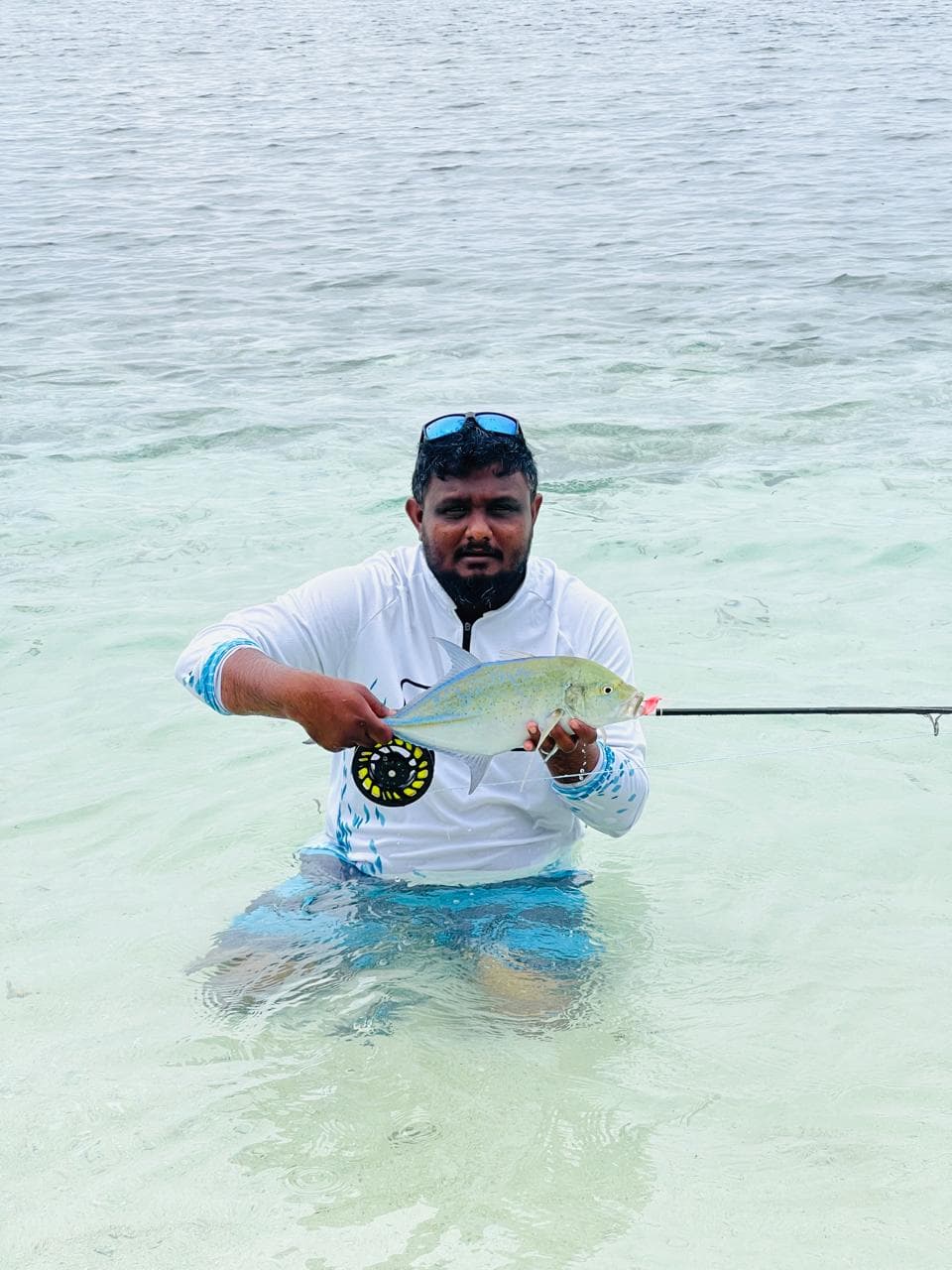
Sight-casting a fly to fish on the flats and reef edges rather than trolling or bait fishing — a specialist technique that rewards accurate casting over shallow, clear water. Our own full-day and half-day fly fishing charters run from the same private operation as our general charters; bring your own fly rod and gear.
Handline (Traditional) Fishing
The traditional Maldivian method — reel, line, hook and bait, no rod required — taught to guests with no experience needed. Usually the base technique on a sunset fishing trip.
Night Fishing
After-dark trips targeting different species than daytime fishing, often paired with a sunset departure. A genuinely different experience from a standard sunset trip, not just the same thing later.
Reef Fishing
Bottom and light-tackle fishing over the reef itself, usually calmer and closer to shore than a big-game run — a good option for a shorter trip or less experienced anglers.
Sport Fishing
A broader private-charter style trip, often targeting whatever's running that day rather than one specific technique — closest in spirit to MFH's own full-day and half-day private charters.
Traditional Fishing
Multi-technique trips run by local fishermen or resort dhonis, sometimes spanning several traditional methods in one outing rather than one specific style.
Fishing Operators
Real operators running fishing trips on record in this directory.
Maldives Fishing Packages
See all fishing packages (19) →Multi-night fishing holidays combining accommodation, full-board meals, transfers and a private charter — from 2 to 8 nights, verified against our own packages rate sheet.
 MaamendhooFishing Holiday Packages2 Nights / 1 DaysFrom USD 825 per person
- Stay at Maldives Fishing and Holidays Lodge
- Private Full-Day Fishing Charter
- Based in Maamendhoo
 MaamendhooFishing Holiday Packages2 Nights / 1 DaysFrom USD 765 per person
- Stay at Maldives Fishing and Holidays Lodge
- Private Half-Day Fishing Charter
- Based in Maamendhoo
 MaamendhooFishing Holiday Packages3 Nights / 2 DaysFrom USD 1,235 per person
- Stay at Maldives Fishing and Holidays Lodge
- Private Full-Day Fishing Charter
- Based in Maamendhoo
 MaamendhooFishing Holiday Packages3 Nights / 2 DaysFrom USD 1,025 per person
- Stay at Maldives Fishing and Holidays Lodge
- Private Half-Day Fishing Charter
- Based in Maamendhoo
 MaamendhooFishing Holiday Packages3 Nights / 2 DaysFrom USD 625 per person
- Stay at Maldives Fishing and Holidays Lodge
- Fly Fishing Full-Day Charter
- Based in Maamendhoo
 MaamendhooFishing Holiday Packages4 Nights / 3 DaysFrom USD 1,620 per person
- Stay at Maldives Fishing and Holidays Lodge
- Private Full-Day Fishing Charter
- Based in Maamendhoo
Maldives Fishing Seasons
The Maldives sits close enough to the equator that temperature barely changes year-round — what shifts is the monsoon, and with it sea conditions. The northeast monsoon (roughly December to April) brings calmer seas and clearer water, generally easier conditions for trolling and offshore trips. The southwest monsoon (roughly May to November) brings rougher water and more rain, though it can also stir up baitfish activity that some techniques benefit from.
There isn’t one single best month for every kind of fishing — a calm-water technique like trolling for tuna and wahoo can be productive through the northeast monsoon, while channel and reef fishing depend more on tide and current than on the season itself. Conditions vary year to year too, so treat any seasonal guidance as a general pattern rather than a guarantee.
Fishing Gallery
Real photos from Maldives fishing charters and catches — the boat, the crew, and what comes up on the line.


Fishing in the Maldives — Video
A look at what a real Maldives fishing trip looks like on the water.
Types of Fishes in the Maldives
Over 1,100 fish species inhabit Maldivian waters — from colorful reef dwellers to powerful pelagic predators. Here are the species you’re most likely to see or catch, grouped by where they’re found.
Reef Fish
The vibrant coral reefs of the Maldives support an incredible diversity of reef-dwelling fish species — the backbone of the reef ecosystem and a delight for snorkelers and divers.

Butterflyfish
Chaetodontidae family
- Size:
- 12-22 cm
- Habitat:
- Coral reefs
- Diet:
- Coral polyps, invertebrates
With their distinctive disk-shaped bodies and vibrant patterns, butterflyfish are among the most recognizable reef fish in the Maldives. The archipelago is home to over 40 species, including the iconic Threadfin Butterflyfish and the Raccoon Butterflyfish. They're often seen in pairs, meticulously picking at coral polyps with their specialized snouts.

Angelfish
Pomacanthidae family
- Size:
- 15-45 cm
- Habitat:
- Reef slopes, lagoons
- Diet:
- Sponges, algae, invertebrates
Angelfish are among the most beautiful fish in Maldivian waters, with their vibrant colors and elegant fins. The Emperor Angelfish undergoes a remarkable transformation from its juvenile "blue ring" pattern to the striking yellow and blue adult form. Other common species include the Regal Angelfish and the Semicircle Angelfish.

Parrotfish
Scaridae family
- Size:
- 30-120 cm
- Habitat:
- Coral reefs, lagoons
- Diet:
- Coral, algae
Named for their fused teeth that resemble a parrot's beak, these colorful fish play a crucial role in reef health by cleaning algae and creating sand. The Maldives hosts numerous species, including the Steephead Parrotfish and the Bullethead Parrotfish. Many parrotfish species change color and even gender as they mature.

Wrasse
Labridae family
- Size:
- 10-230 cm
- Habitat:
- Varied reef environments
- Diet:
- Crustaceans, mollusks, fish
The wrasse family includes some of the most diverse and colorful fish in the Maldives. From the tiny Cleaner Wrasse that sets up "cleaning stations" for larger fish to the massive Napoleon Wrasse (which can grow to over 2 meters), these fish are fascinating to observe. The Napoleon Wrasse is protected in the Maldives due to its vulnerable conservation status.

Triggerfish
Balistidae family
- Size:
- 30-75 cm
- Habitat:
- Reef flats, lagoons
- Diet:
- Crustaceans, coral, sea urchins
Known for their oval-shaped bodies and powerful jaws, triggerfish are common throughout Maldivian reefs. The Titan Triggerfish is the largest species and can be territorial, especially during nesting season. The Clown Triggerfish, with its polka-dot pattern, is one of the most visually striking fish in the ocean.

Anemonefish (Clownfish)
Amphiprioninae subfamily
- Size:
- 7-15 cm
- Habitat:
- Sea anemones on reefs
- Diet:
- Algae, zooplankton
Made famous by the movie "Finding Nemo," clownfish or anemonefish are beloved for their bright orange coloration and symbiotic relationship with sea anemones. The Maldives is home to several species, including the Clark's Anemonefish and the Maldives Anemonefish, which is endemic to the region.
Pelagic Fish
The open waters surrounding the Maldives' atolls are home to powerful pelagic species that roam the Indian Ocean, prized by anglers and crucial to the marine ecosystem.

Yellowfin Tuna
Thunnus albacares
- Size:
- Up to 200 cm / 200 kg
- Habitat:
- Open ocean, atoll edges
- Best Season:
- December - March
Yellowfin tuna are powerful, fast-swimming predators identified by their bright yellow fins and streamlined bodies. They're a primary target for sport fishermen in the Maldives and are also commercially important. These fish can be found around the edges of atolls and in open water, often hunting in schools and capable of impressive speeds.

Skipjack Tuna
Katsuwonus pelamis
- Size:
- Up to 100 cm / 20 kg
- Habitat:
- Surface waters, near atolls
- Best Season:
- Year-round
Skipjack tuna are the most abundant tuna species in Maldivian waters and form the backbone of the traditional pole-and-line fishing industry. They're identified by their distinctive dark stripes on the lower body. These fast-growing fish travel in large schools and are often found feeding near the surface, making them accessible to traditional fishing methods.

Giant Trevally (GT)
Caranx ignobilis
- Size:
- Up to 170 cm / 80 kg
- Habitat:
- Reef edges, channels, open water
- Best Season:
- April - October
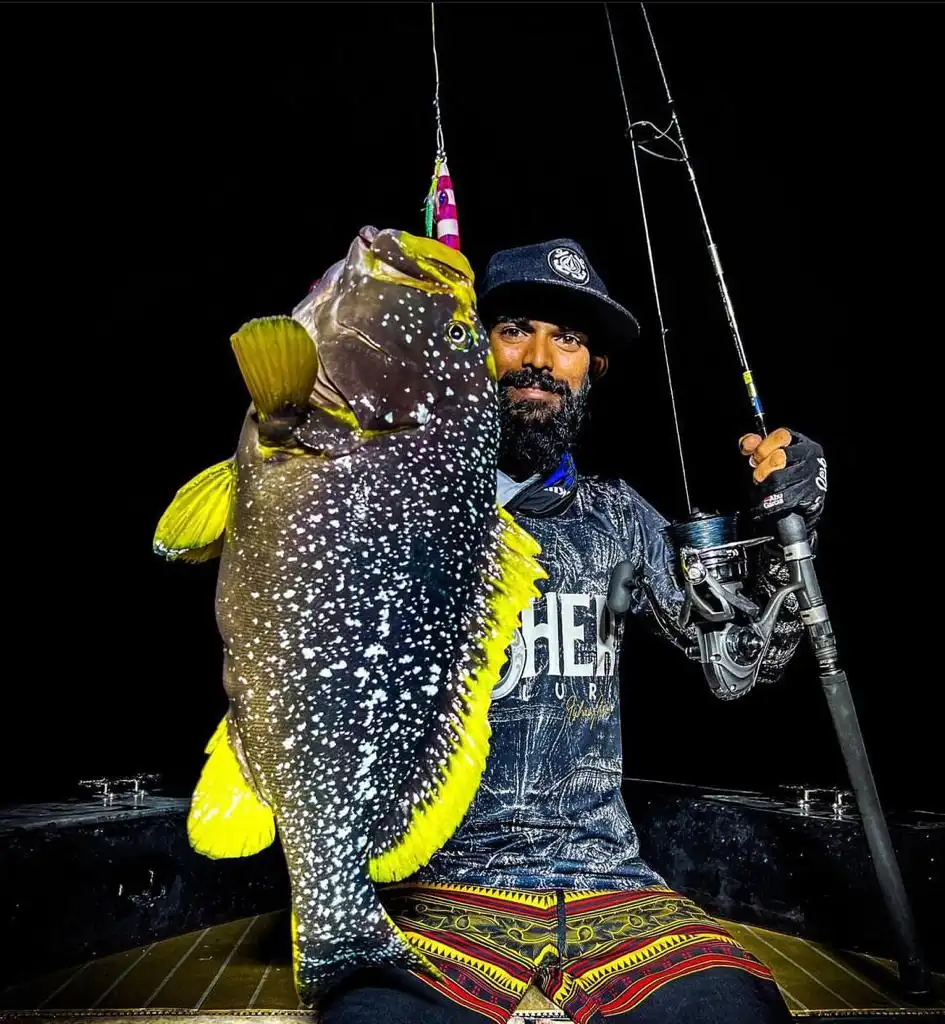
The Giant Trevally or GT is the ultimate sport fishing challenge in the Maldives. These powerful predators are known for their explosive strikes and incredible fighting strength. Silver-gray in color, they patrol reef edges and channels, hunting smaller fish with remarkable aggression. The Maldives is one of the best destinations worldwide for targeting trophy-sized GTs.

Dogtooth Tuna
Gymnosarda unicolor
- Size:
- Up to 130 cm / 70 kg
- Habitat:
- Deep reef slopes, drop-offs
- Best Season:
- November - April
Named for their prominent, dog-like teeth, Dogtooth Tuna are powerful predators that inhabit the deeper reef slopes and drop-offs around Maldivian atolls. They're known for their incredible fighting ability and tendency to dive deep when hooked. These solitary hunters are prized catches for experienced anglers using jigging techniques.

Wahoo
Acanthocybium solandri
- Size:
- Up to 250 cm / 80 kg
- Habitat:
- Open ocean, atoll edges
- Best Season:
- December - March
Wahoo are among the fastest fish in the ocean, capable of speeds up to 80 km/h. Their streamlined, torpedo-shaped bodies and razor-sharp teeth make them formidable predators. In the Maldives, they're often found near the edges of atolls and are prized for both their fighting ability and excellent taste. Trolling is the most effective method for targeting wahoo.

Mahi-Mahi (Dolphinfish)
Coryphaena hippurus
- Size:
- Up to 210 cm / 40 kg
- Habitat:
- Open ocean, floating debris
- Best Season:
- December - April
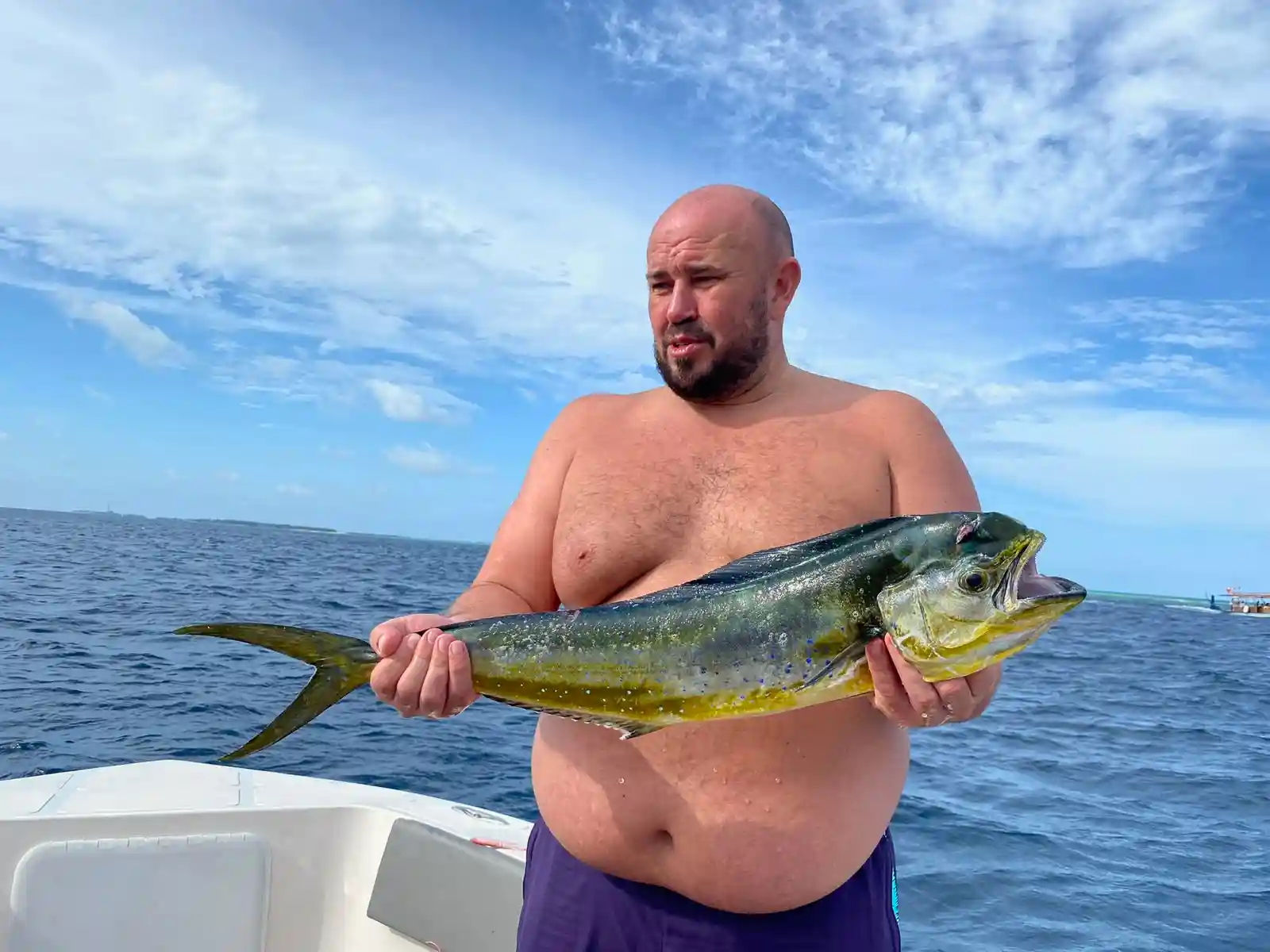
With their vibrant colors and distinctive blunt head, Mahi-Mahi are among the most beautiful pelagic fish. Males develop a prominent forehead as they mature. These fast-growing fish are often found near floating debris or FADs (Fish Aggregating Devices) and are known for their acrobatic jumps when hooked. They're excellent table fare and a popular target for sport fishermen.
Bottom Dwellers
The sandy bottoms, reef bases, and rocky areas of the Maldives are home to a variety of bottom-dwelling species, both ecologically important and prized by anglers.

Groupers
Epinephelinae subfamily
- Size:
- 30-250 cm (species dependent)
- Habitat:
- Reef caves, drop-offs
- Diet:
- Fish, crustaceans
The Maldives is home to numerous grouper species, from the colorful Coral Grouper to the massive Goliath Grouper. These ambush predators typically hide in reef crevices and caves, darting out to capture prey. Many grouper species change sex from female to male as they grow larger. They're highly prized for their firm, white flesh but are vulnerable to overfishing.

Snappers
Lutjanidae family
- Size:
- 30-100 cm (species dependent)
- Habitat:
- Reef edges, sandy bottoms
- Diet:
- Fish, crustaceans, mollusks
Snappers are common throughout Maldivian waters, with species like the Red Snapper and Humpback Snapper being particularly abundant. These fish are characterized by their strong teeth and are often found in schools around reef edges and drop-offs. They're popular targets for bottom fishing and provide excellent eating.

Emperor Fish
Lethrinidae family
- Size:
- 30-100 cm (species dependent)
- Habitat:
- Sandy areas, lagoons, reef flats
- Diet:
- Crustaceans, mollusks, small fish
Emperor fish, including the popular Spangled Emperor, are common in the sandy areas and reef flats of the Maldives. They have powerful jaws designed for crushing shells and crustaceans. These fish are easily identified by their slightly elongated snouts and bright coloration. They're excellent table fish and a common target for both traditional and modern fishing methods.

Sweetlips
Haemulidae family
- Size:
- 30-60 cm
- Habitat:
- Reef slopes, caves
- Diet:
- Crustaceans, worms
Named for their thick, fleshy lips, sweetlips are striking fish with distinctive spotted or striped patterns. The Oriental Sweetlips and Harlequin Sweetlips are common in Maldivian waters. Juveniles have even more dramatic patterns and perform a unique "dancing" swimming style. These fish are typically found in small groups around reef slopes and caves.
Sharks & Rays
The Maldives is a sanctuary for various shark and ray species, which play crucial roles in maintaining healthy marine ecosystems. Many are protected under Maldivian law.

Reef Sharks
Carcharhinidae family
- Size:
- 1.5-2.5 meters
- Habitat:
- Reef edges, lagoons
- Status:
- Protected in Maldives
Blacktip and Whitetip Reef Sharks are common sights in the Maldives, patrolling the edges of reefs and lagoons. These elegant predators are generally shy around humans and play a vital role in maintaining reef health by removing weak or sick fish. All shark species are protected in the Maldives, with shark fishing banned since 2010.
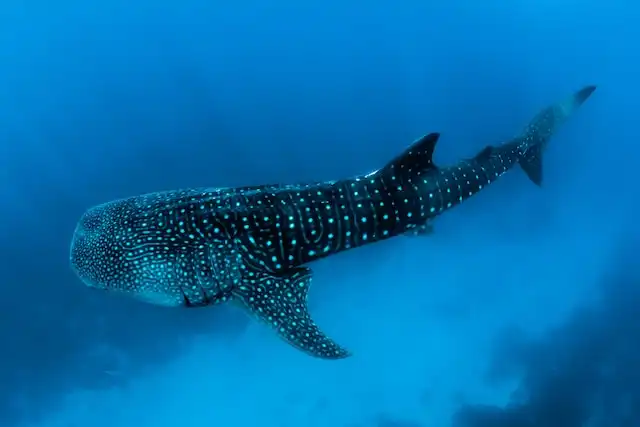
Whale Shark
Rhincodon typus
- Size:
- Up to 12 meters
- Habitat:
- Open ocean, feeding aggregations
- Status:
- Endangered, fully protected
The gentle giants of the ocean, Whale Sharks are the world's largest fish and a highlight for many visitors to the Maldives. Despite their enormous size, they feed primarily on plankton and small fish. South Ari Atoll is famous for year-round whale shark sightings, while Hanifaru Bay in Baa Atoll hosts seasonal feeding aggregations.

Manta Ray
Mobula alfredi (Reef Manta)
- Size:
- 3-5 meters wingspan
- Habitat:
- Cleaning stations, feeding areas
- Status:
- Vulnerable, protected
The Maldives is home to the world's largest known population of reef manta rays, with over 5,000 individuals identified. These graceful creatures are frequently spotted at cleaning stations where smaller fish remove parasites from their bodies. Hanifaru Bay in Baa Atoll is famous for its spectacular manta feeding aggregations during the southwest monsoon.

Stingrays
Dasyatidae family
- Size:
- 0.5-2 meters disc width
- Habitat:
- Sandy bottoms, lagoons
- Status:
- Protected in Maldives
Various species of stingrays inhabit the sandy bottoms and lagoons of the Maldives. These flat, disc-shaped fish are often partially buried in sand with only their eyes visible. The Bluespotted Stingray, with its distinctive blue spots on a sandy-colored body, is a common sight in shallow lagoons.
Responsible Fishing in the Maldives
Most operators on this page practice catch and release for anything not being kept for the table, handling fish carefully to give them the best chance after release — wet hands, minimal time out of the water, and a quick, careful unhooking. Anchoring away from live coral and following the crew’s lead on where fishing is and isn’t appropriate near a given island protects the same reefs the fishing itself depends on.
Rules and protected areas vary by atoll and can change — your operator’s crew is the right source for anything specific to where you’re fishing, rather than a general guide like this one.
Maldives Fishing Reports
We don’t have real fishing reports published yet — when we do, each one will cover a real trip: date, location, technique used, species caught, sea conditions, the boat, trip duration and photos from that specific day. Check back here as real trips get logged.
Explore Maldives Fishing
Fishing Guides
In-depth guides from our Travel Guide, covering seasons, techniques and a real operator writeup.
- Maldives Fishing Seasons: A Month-by-Month Guide

When to target which species around the Maldives' atolls, from the northeast monsoon's tuna and wahoo run to the giant trevally season that follows it.
Fishing6 min read - Maldives Fishing Techniques: Trolling, Jigging, Popping and Handline Fishing Explained

A plain guide to the main fishing techniques used around Maldivian atolls — trolling, jigging, popping and handline fishing — and which species each one targets.
Fishing6 min read - Fishing in Gaafu Atoll: A Guide to Maldives Fishing and Holidays Lodge on Maamendhoo

The charter boat, pricing and multi-night packages run by Maldives Fishing and Holiday Pvt Ltd from its lodge on Maamendhoo, Gaafu Alifu Atoll.
Fishing5 min read
Explore More Maldives
Frequently Asked Questions
- What does a private fishing charter in the Maldives cost?
- Our own 32-foot private charter starts from USD 980 for a half day or USD 1,380 for a full day, per boat (up to 5 passengers) — see Fishing Charters below for the exact, currently-verified rate.
- What's the difference between a fishing charter and a fishing package?
- A charter is the boat trip itself, for a half or full day. A package bundles a charter with accommodation, meals and transfers for a multi-night stay — see Fishing Packages below.
- Do I need fishing experience?
- No — basic fishing gear and a professional captain and crew are included on every charter on this page, and traditional handline fishing needs no prior experience.
- What fish can I catch in the Maldives?
- It depends on the technique and season — big game trips target tuna, wahoo, sailfish and marlin further offshore; reef and handline trips catch a wider range of reef species closer to shore. See Fishing by Technique below.
- Can I combine fishing with a resort stay?
- Yes — many resorts on this site (see Fishing by Technique and the activities below) run their own fishing trips alongside a normal resort stay, separate from our own dedicated fishing packages.
- Are prices on this page fixed?
- Prices shown are the operator's current verified rate, subject to their own booking conditions — availability, fuel surcharges and operational costs can change rates without notice. Enquire to confirm before booking.
- Can I catch giant trevally in the Maldives?
- Yes — giant trevally are a common target for popping and jigging trips over channel edges and outer reef, including the Gaafu Atoll charters on this page. As with any wild fish, a catch isn't guaranteed on a given day.
- Is fishing available from local islands, not just resorts?
- Yes — several charters on this page, including our own Gaafu Atoll operation, are run from local islands rather than resorts, alongside independent Maafushi-based operators.
- Do you provide fishing equipment?
- Basic fishing gear is included on the private charters on this page. If you have your own preferred rod or reel, you're welcome to bring it — check with the operator when booking.