
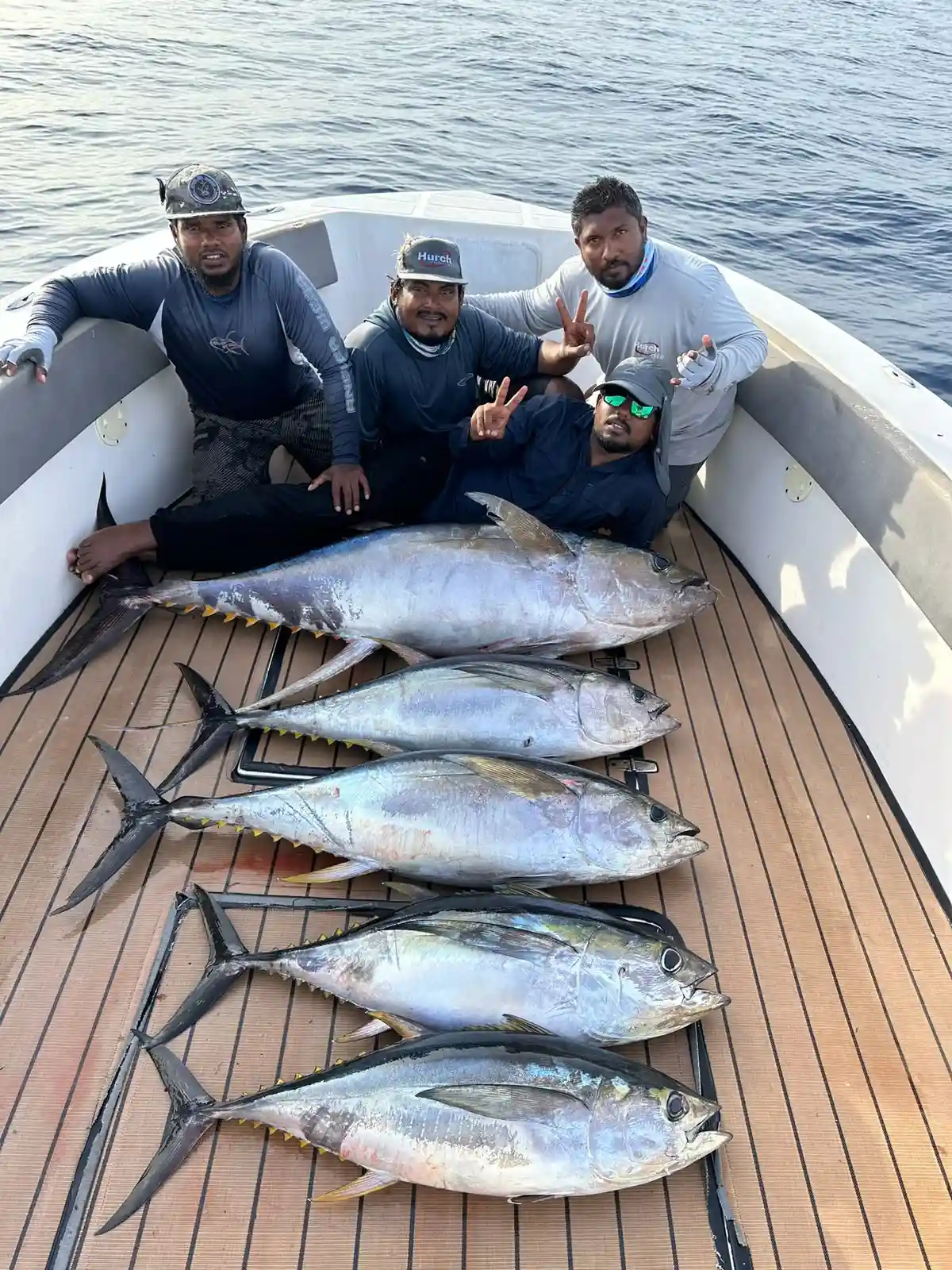
Tuna is to the Maldives what wine is to France. The fish has fed Maldivians for centuries, built the country's fishing fleet and its biggest export, and still turns up at almost every meal. For anglers, the Maldives offers three very different tuna: hard-fighting yellowfin offshore, fast skipjack in huge schools, and powerful dogtooth tuna on the deep reef. This guide covers tuna fishing in the Maldives: the species, the seasons, the techniques, the traditional pole-and-line fishery, and how to book a tuna fishing trip.
Tuna species in the Maldives
Yellowfin tuna
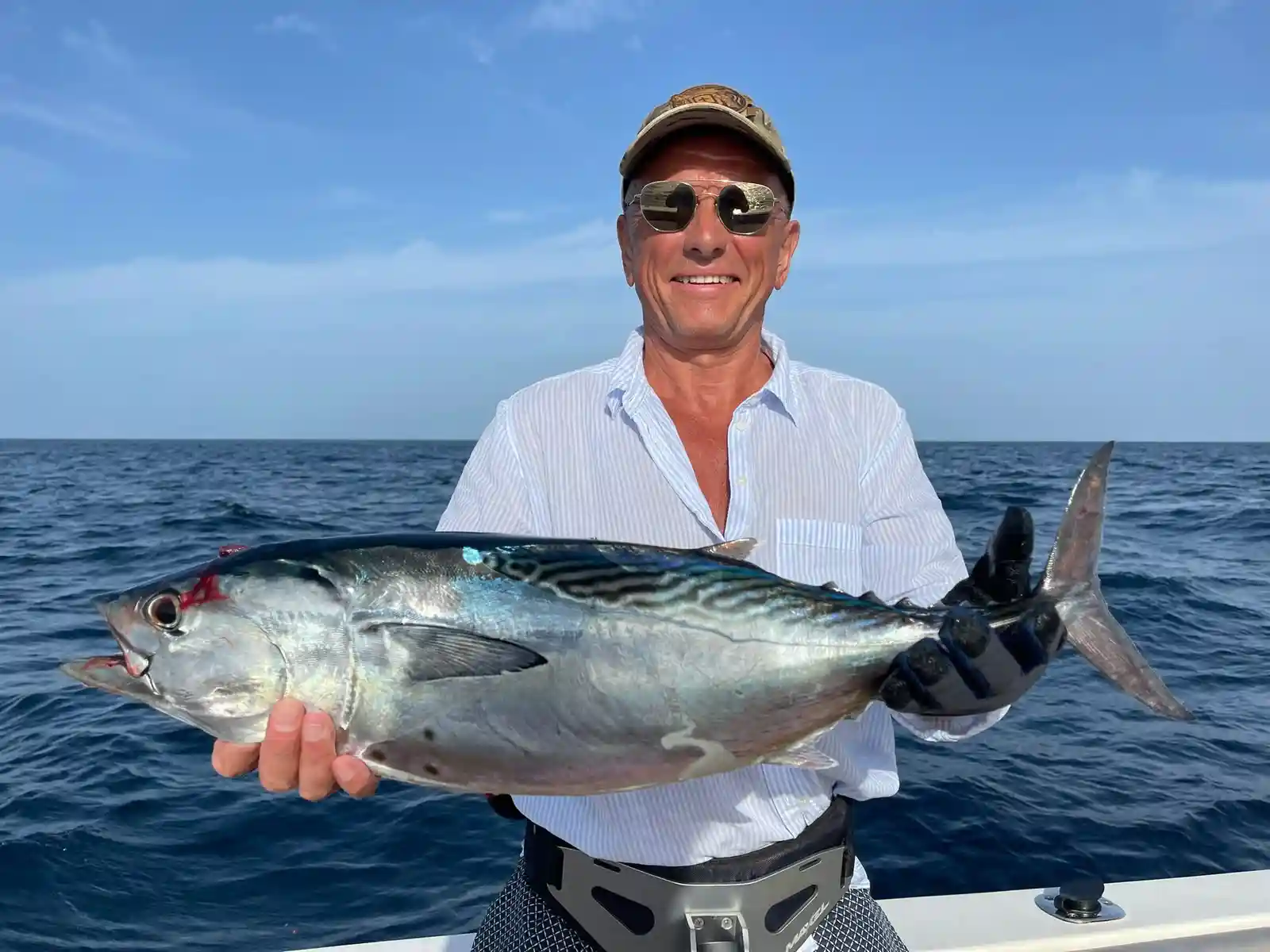
Yellowfin tuna are the prize of offshore tuna fishing in the Maldives. They have long, bright yellow second dorsal and anal fins and yellow finlets, and they are fast, strong fish that fight hard all the way to the boat. Yellowfin hunt in the open ocean beyond the atoll rims, often under flocks of diving seabirds or alongside dolphins. Read more about yellowfin tuna fishing in the Maldives.
Skipjack tuna
Skipjack are smaller tuna with dark stripes along the belly. They travel in large, fast-moving schools and are the backbone of the Maldives' traditional pole-and-line fishery. For sport anglers, a skipjack school boiling on the surface is fun on light tackle, and skipjack are also used as bait for bigger fish.
Dogtooth tuna
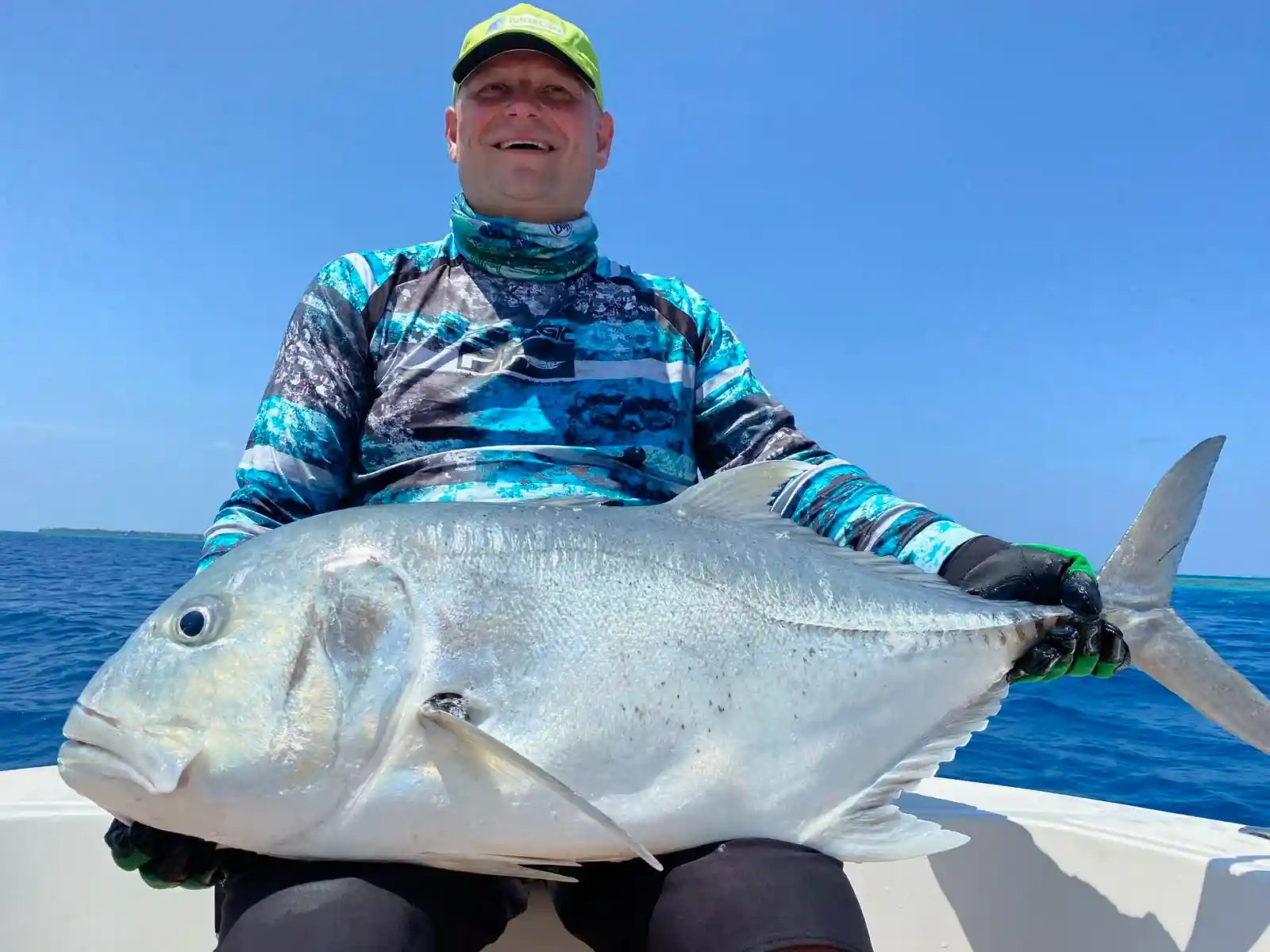
Dogtooth tuna are not true schooling tuna but reef predators with sharp, conical teeth. They live along deep reef walls and drop-offs, grow very large and are one of the hardest-fighting fish an angler can hook on the reef. Most are caught by jigging. See our dogtooth tuna fishing guide.
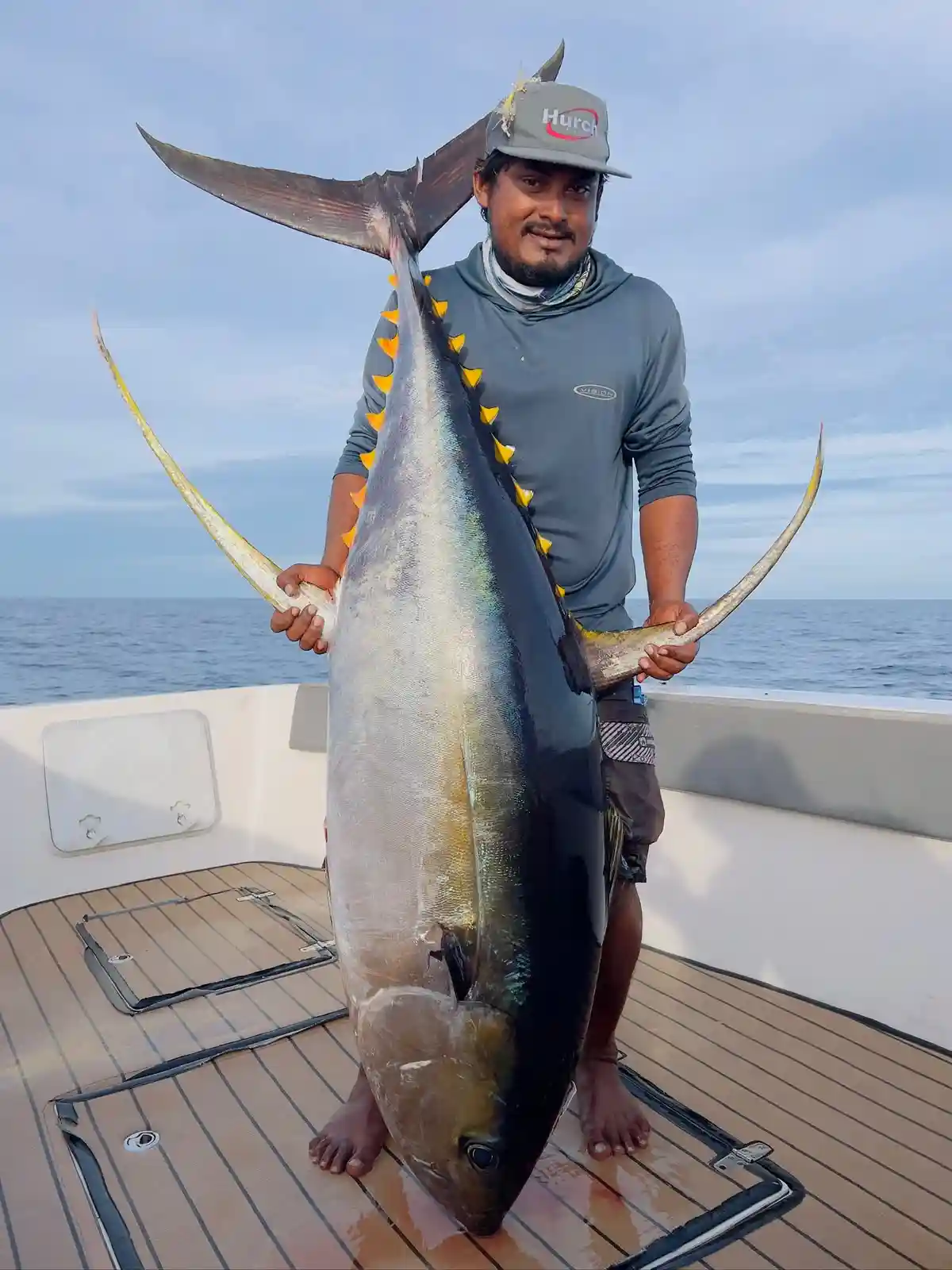
How big do tuna get in the Maldives?
| Species | Maximum size | Where they live |
|---|---|---|
| Yellowfin tuna | Up to 200 cm / 200 kg | Open ocean beyond the atolls |
| Dogtooth tuna | Up to 130 cm / 70 kg | Deep reef slopes and drop-offs |
| Skipjack tuna | Up to 100 cm / 20 kg | Open ocean, in large schools |
Most tuna caught on a day trip are well below these maximums, but even a medium-sized yellowfin or dogtooth will test your tackle and your arms.
Best time for tuna fishing in the Maldives
| Species | Season | Main technique |
|---|---|---|
| Yellowfin tuna | December to March | Trolling, popping into feeding schools |
| Dogtooth tuna | November to April | Jigging the deep reef slopes |
| Skipjack tuna | All year | Trolling small lures, pole and line |
The calmer northeast monsoon, from December to April, is the best time for offshore tuna fishing in general: the sea is flatter, trolling is more comfortable, and yellowfin, wahoo and mahi-mahi are all in season. These seasons come from the species records in our Maldives fish species guide; they vary by atoll and year, so treat them as a guide. For every species month by month, see the best time to fish in the Maldives.
How to catch tuna in the Maldives
Trolling for tuna
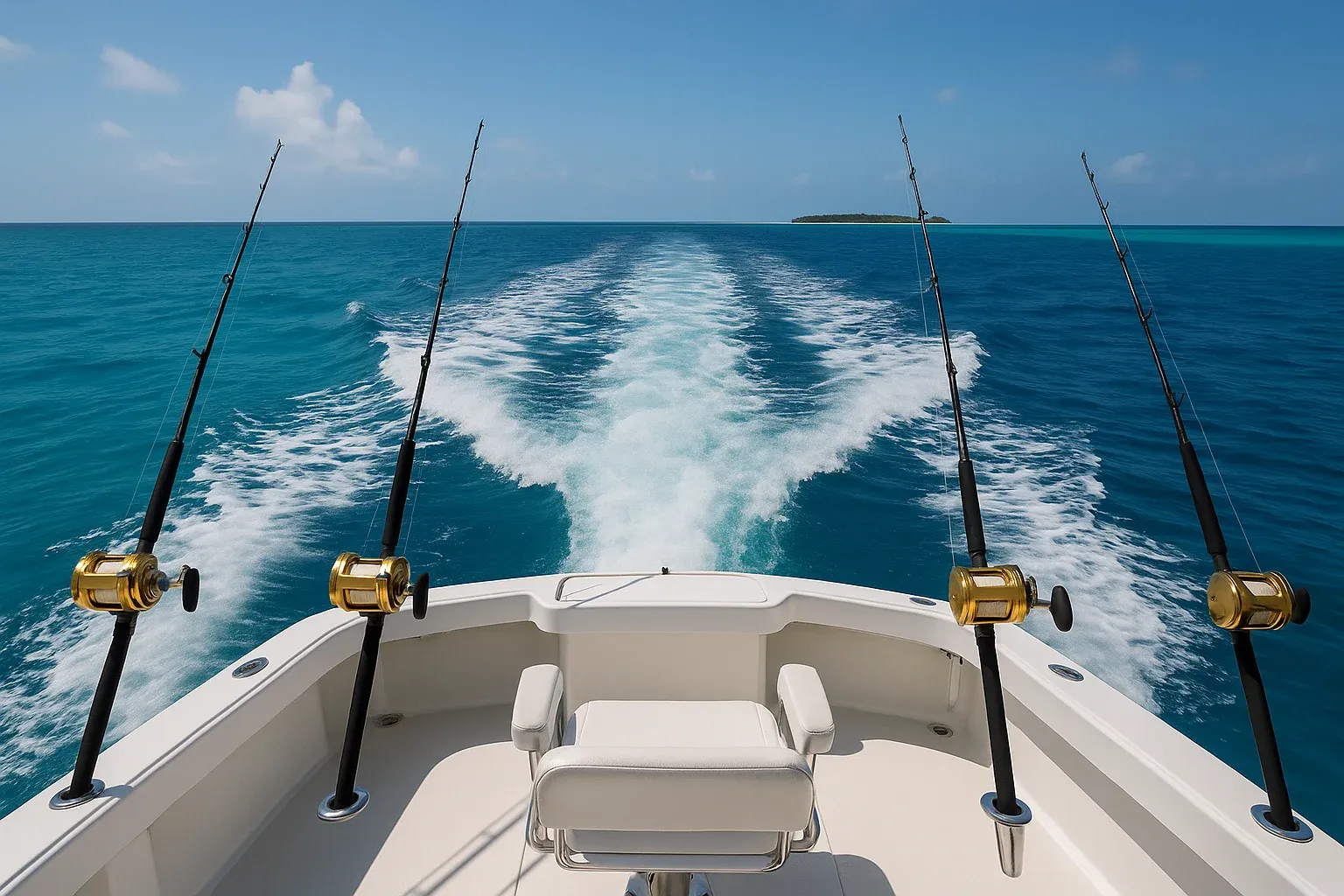
Trolling is the most common way to catch yellowfin and skipjack. The boat runs offshore with several lures or rigged baits towed behind it at speed, searching for birds working the surface, floating debris or signs of feeding fish. When a tuna strikes, the reel screams and the angler takes the rod. Trolling also catches wahoo, mahi-mahi and, occasionally, sailfish and marlin. Read more about trolling in the Maldives.
Popping and casting to tuna
When yellowfin are feeding on the surface, casting poppers or stickbaits into the school can produce spectacular strikes. It takes quick boat handling and accurate casting, and it is one of the most exciting ways to catch tuna.
Jigging for dogtooth tuna
Dogtooth tuna are caught by dropping heavy metal jigs down the outer reef walls and working them back up. The strike can come deep, and a big dogtooth will try to reach the reef immediately, so heavy tackle and a tight drag are essential. Our popping and jigging guide explains the technique and tackle.
Where to go tuna fishing in the Maldives
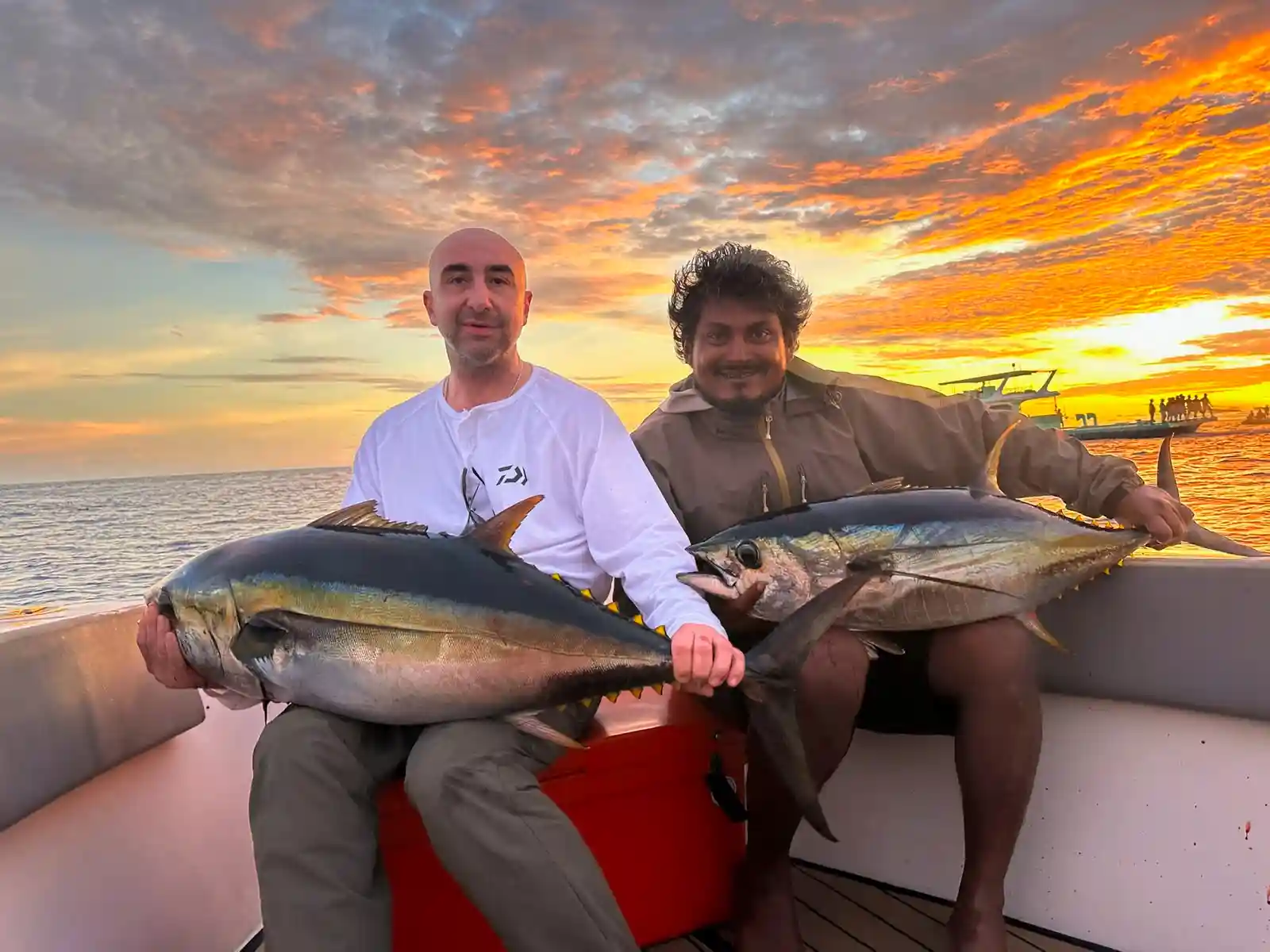
Yellowfin and skipjack live in the open ocean, so tuna fishing means heading out beyond the atoll rim into deep blue water. Boats look for birds working the surface, schools breaking on top, floating logs and debris, and the fish aggregating devices (FADs) anchored offshore, which attract baitfish and the tuna that feed on them. Dogtooth tuna, by contrast, are found close to the atolls, along the steep outer reef walls and at the mouths of deep channels.
The southern atolls are a good base for both. In Gaafu Alifu Atoll, deep ocean water lies just outside the reef, so the boat can troll for yellowfin offshore in the morning and jig the reef walls for dogtooth tuna later in the day, without long runs between the two.
Tuna fishing tackle
- Trolling: heavy trolling rods and lever-drag reels, with skirted lures, diving lures and rigged baits. The boat supplies trolling tackle.
- Popping to tuna: a heavy spinning rod and reel with strong braid, and poppers or stickbaits that match the size of the bait the tuna are feeding on.
- Jigging for dogtooth tuna: a strong jigging rod and reel, heavy metal jigs with assist hooks, and a thick fluorocarbon leader.
Basic gear is included on our charters, and a professional rod and reel setup for popping or jigging is USD 80 per setup.
Pole-and-line tuna fishing: a Maldivian tradition
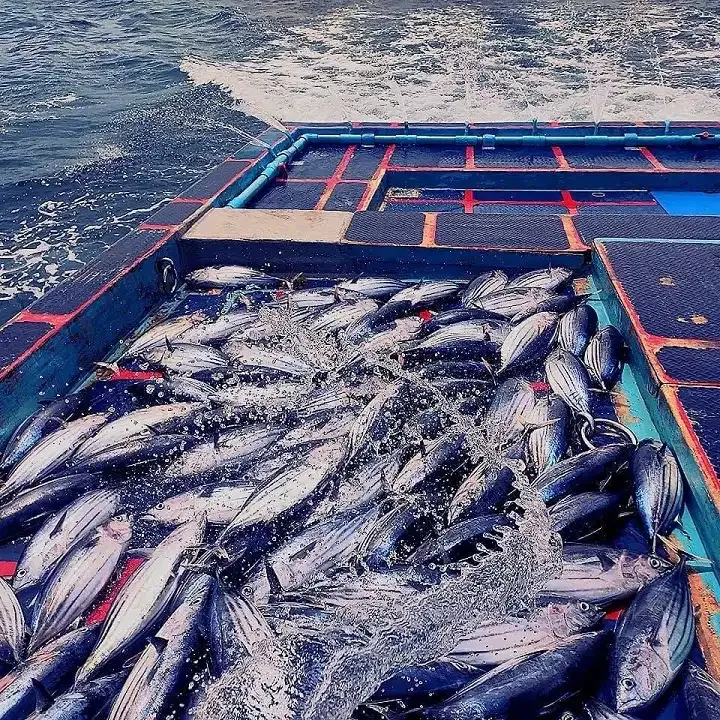
For centuries, Maldivian fishermen have caught skipjack and young yellowfin one at a time using bamboo poles, lines and barbless hooks. A traditional fishing dhoni finds a school, the crew throws live bait into the water and sprays the surface to make the fish feed, and the fishermen hook tuna after tuna, swinging each one onto the deck in a single movement. Because fish are caught one by one, with no nets, the method has very little bycatch, and it is widely seen as one of the most sustainable ways to catch tuna in the world.
Pole-and-line fishing still supplies much of the tuna eaten in the Maldives, from mas huni at breakfast to garudhiya fish soup. Visit the fish market in Malé in the afternoon and you'll see the day's catch of skipjack and yellowfin laid out on long tables. Read more in our guide to traditional Maldivian fishing.

Tuna fishing charters in the Maldives
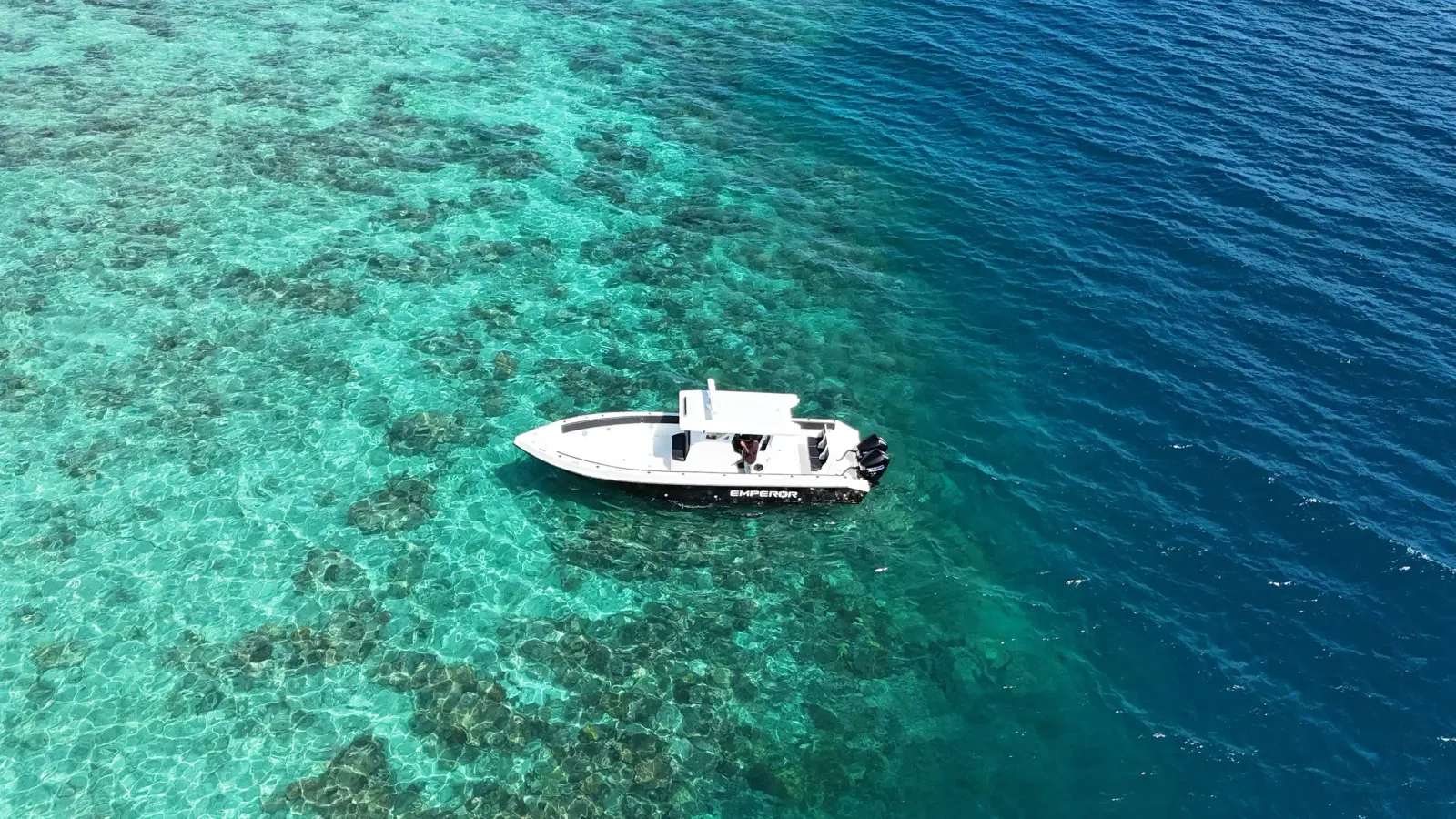
To catch tuna yourself, you need a boat that can run offshore. Our private charter boat, Emperor, is a 32-foot fishing boat with twin 200 HP engines for up to 5 anglers, based in Gaafu Alifu Atoll in the south of the Maldives. The crew trolls offshore for yellowfin and skipjack, casts to feeding schools, and jigs the reef walls for dogtooth tuna, so one day can cover all three tuna as well as wahoo, mahi-mahi and giant trevally.
A full-day charter costs USD 1,380 per boat and a half day USD 980, including the captain and crew, fuel, soft drinks and snacks, and basic gear. For offshore tuna, a full day gives you time to run out to the fish and find the schools.
- Private Full-Day Fishing Charter
 Fishing51 locations8 hrFrom $1,380
Tuna fishing holidays and packages
For several days of tuna fishing, our packages at the Maldives Fishing and Holidays Lodge on Maamendhoo, Gaafu Alifu, include full-board accommodation, the return domestic flight, the boat transfer and a private Emperor charter on every fishing day. A 5-night package with 4 full fishing days costs USD 3,670 per person for 2 anglers or USD 1,870 per person for 5.
 MaamendhooFishing Holiday Packages5 Nights / 4 DaysFrom $1,870 per person
- Stay at Maldives Fishing and Holidays Lodge
- Private Full-Day Fishing Charter
- Based in Maamendhoo
See all fishing packages or our Maldives fishing trip cost guide.
Tips for tuna fishing in the Maldives
- Go early. Tuna often feed hardest in the first hours of daylight.
- Watch the birds. Diving seabirds are the best sign of tuna feeding below.
- Book a full day for yellowfin. Offshore fish take time to find.
- Pick the season. December to March for yellowfin, November to April for dogtooth.
- Keep only what you'll eat. Fresh tuna is one of the best meals in the Maldives, but release what you don't need.
Tuna fishing in the Maldives: FAQs
When is tuna season in the Maldives?
Yellowfin tuna peak from December to March and dogtooth tuna from November to April. Skipjack tuna are caught all year.
What is the best way to catch tuna in the Maldives?
Trolling offshore for yellowfin and skipjack, casting poppers into feeding schools, and jigging the deep reef walls for dogtooth tuna.
Can I go tuna fishing on a day trip?
Yes. A private full-day charter gives you time to run offshore and find tuna. On Emperor, a full day costs USD 1,380 per boat for up to 5 anglers.
What is pole-and-line fishing?
A traditional Maldivian method of catching tuna one at a time with a pole, line and barbless hook, using live bait to bring the school to the boat. It has very little bycatch.
Is dogtooth tuna a real tuna?
Dogtooth tuna belong to the same family as other tunas and mackerels, but they behave more like reef predators, living along deep reef walls rather than travelling in open-ocean schools.
Can I eat the tuna I catch?
Ask the crew. Tuna kept for the table is often prepared fresh, and Maldivian tuna dishes are among the best things to eat on a fishing holiday.